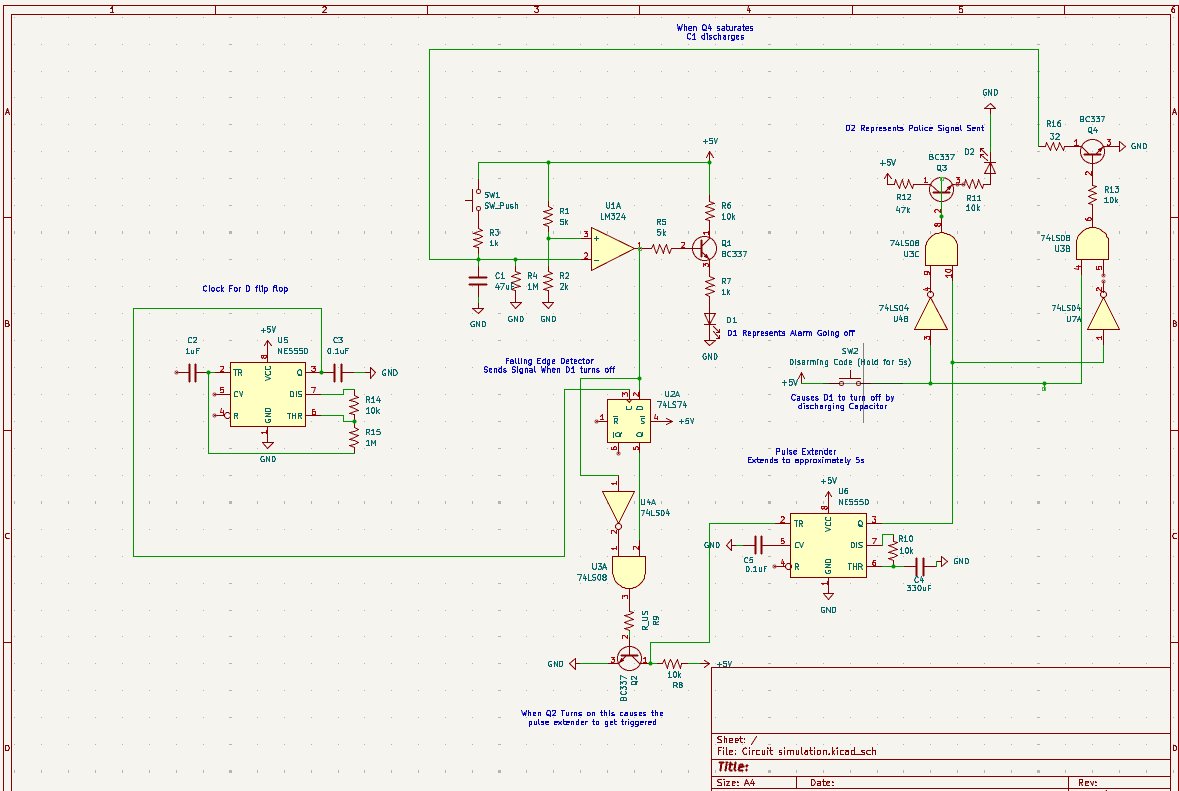
• Schematic of PCB design
    3D model of PCB design in Altium Software

    What is it?

    This is a PCB of a standard circuit: Astable Multivibrator. LEDs alternate, meaning that one is on and the other is off. This happens continuously, creating a blinking pattern.

    How was this built?

    Altium was used in the design process. First, a schematic was created. The schematic was then exported into the PCB editor. I used through-hole components and a via connected the ground plane on the bottom layer. After completing the layout, I exported Gerber and Drill files to a PCB manufacturer. Once the PCBs arrived, I soldered the components into the board.

    Why was it built?

    This project was created to develop proficiency in Altium and Soldering, both of which are industry-standard skills. Designing and soldering a simple PCB provided a hands-on way to gain experience.
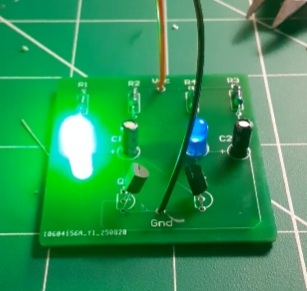
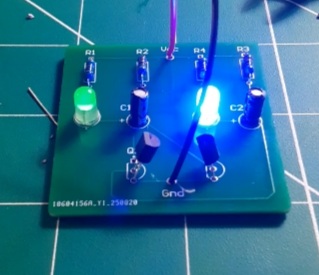
    Images showing the completed PCB
  • Diagram of Circuit
    Schematic of Burglary Alarm System

    What is it?

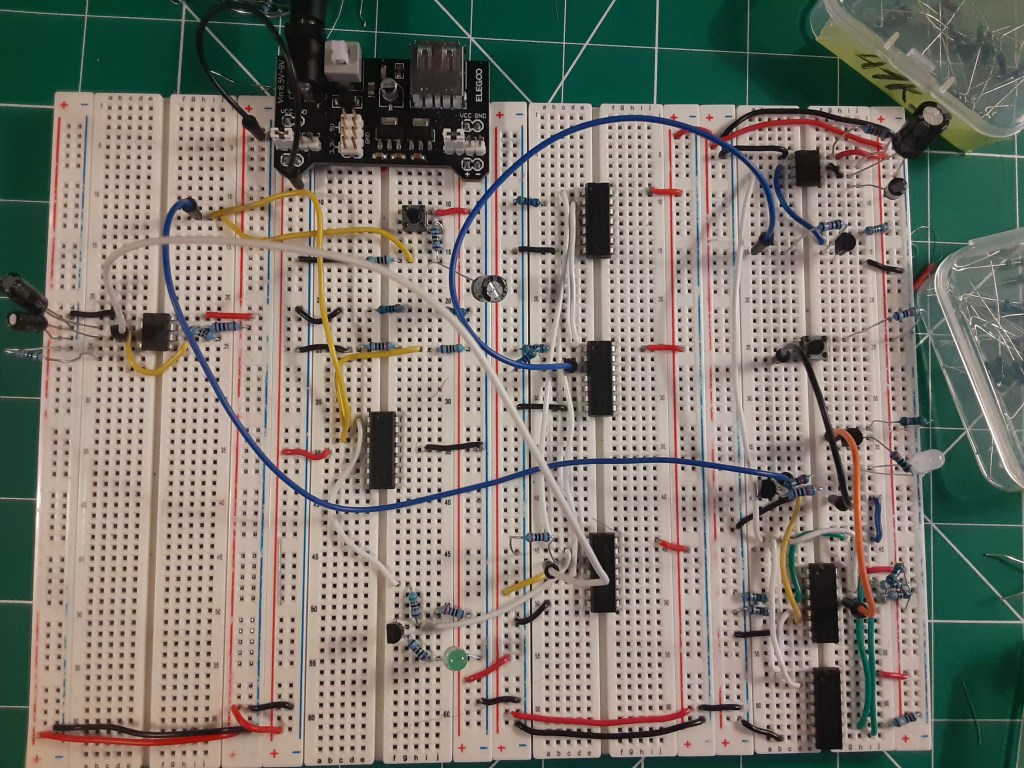
    A burglary alarm system that uses LEDs and push buttons to represent an alarm being tripped (SW1), an alarm going off (D1), an alarm being disarmed (SW2), and a police signal being sent (D2).

    How was this built?

    Built using only Hardware. ICs like the NE555 and the 74XXXX series were vital in determining the correct logic.

    Transistors ensured LED’s turned on without the influence of noise and to be able to use voltage levels (Base of Q1) to send signals indicating that the alarm going off (D1) was turned off.

    Due to the finicky nature of ICs, noise reduction was crucial in the working of the circuit. Decoupling capacitors (C3, look at “Clock for D flip flop”), pull-up and pull-down resistors (for the 74XXXX series) were used to make sure that the signals being detected were the right ones and were not just noise.

    Why did I build this?

    This was my first-ever project, and I know that as a future engineer, I want to design electronic systems that positively impact people’s lives on a day-to-day basis. Therefore, I decided to create a circuit that can be applied to real-life situations, such as a security system.

    I wanted to challenge myself, so I created one rule: Do not use a microcontroller. This led me to gain a strong understanding of electronics principles and circuit design.

    Burglary Alarm System finished project